OER case studies
Learn more about the experiences of staff across the University of Sheffield involved in creating, using and sharing open educational resources.

About
Open Educational Resources (OER) are learning, teaching and research materials in any format and medium that reside in the public domain or that have been released under an open licence.
The University of Sheffield established an Open Educational Resources Policy (PDF, 132 KB) in 2022, highlighting the degree to which it supports and encourages the re-use, re-purposing and adaptation of existing OER to support teaching and learning, and also supports and encourages those who wish to create and share their own OER.
These case studies bring together the experiences of staff across the University who have created, or are in the process of creating, their own OER. Colleagues discuss their reasons for creating an OER, the platforms they chose to use, and the benefits they have observed, both for their own students' learning experiences and the wider educational community.
Written case studies
- Dr Alexis Moschopoulos, University Tutor, School of Education
Motivation
I firmly believe that access to information should be free, but there are many additional reasons why I started using OERs in my teaching. As I was redeveloping the curriculum in my Foundation Year psychology module I found that traditional textbooks were not always suitable. They either didn’t cover the topic I was teaching, didn’t include exciting new research findings, or went into too much detail for the needs of my students. The psychology open resources I use allow for greater flexibility in the topics I teach, are sometimes more up to date than traditional textbooks, and are more accessible and pitched at the right level for my students. The formats of OERs are more readable on digital devices, which appear to be the most common way students now access reading materials, and include interactive quizzes and other methods to check student understanding and engagement. It feels very exciting using materials that are published under licences that align with my moral philosophy on the accessibility of information but are also excellent quality learning materials in their own right.
I was thrilled to learn that the University strongly supports the use and creation of OERs. Online, interactive and multimedia OERs link to the University's Education strategy digital experience priority, and OERs can be customised, contextualised, and made more inclusive and diverse. There is also an extremely supportive group of colleagues in the library and in the wider learning and teaching community who enthusiastically promote OERs at the university, and who offer support on creating and publishing new OERs or or using and repurposing existing ones.
Process
When I started in the Foundation Year I first taught biology. The previous tutor had assigned several chapters from an OER textbook in the weekly reading materials, which served to introduce me to these resources in their modern form. However, I wasn’t aware that these were available for other subjects. When I moved to teaching psychology and wanted to redevelop the curriculum, my colleague Willy Kitchen recommended a few excellent psychology OERs, opening my eyes to the diversity and quality of these resources in a wide range of disciplines. Foundation Year students have found these interactive and digitally accessible resources more suited to their style of learning than traditional textbooks.
All of the open resources used for my module have been added to the Leganto reading list, which allows for easy access by students but also gives clear metrics on resource use. Looking at these metrics shows the engagement with the reading list is high - all students have accessed it, all resources have been viewed by at least one student, and some particular resources are very highly viewed.
Benefits and impact
Using OERs has allowed me to tailor reading lists and session content to more easily meet learning objectives. For example, the classic textbook Psychology: The Science of Mind and Behavior (Gross 2020) doesn’t have any material on the topic of creativity, which I wanted to teach one week this semester. As it happens the excellent psychology open resource NOBA had only recently published a chapter on creativity by one of the leading researchers in the field (Simonton 2026), which I was able to assign as reading and use in creating my lesson. In my experience students find these OERs engaging and accessible, and as they learn more about the costs of accessing traditional textbooks and journal articles, they appear increasingly supportive of open resources.
What’s next for you with OER?
I am very keen to spread the word about OERs in my School and faculty. I know that a few tutors use them already but I don’t think most people are aware of the diversity of OERs available or of the support available from colleagues in the OER Steering Group.
Using OERs in my teaching has also made me want to create my own. OERs are an excellent opportunity to widen the impact of my teaching to students and teachers outside of the University by making resources freely available. That creating OERs is supported by University policy makes the idea even more appealing. Sharing multimedia OERs is also an excellent way to engage with people considering applying to study at University and I am very excited to see how this pans out in the future.
Take a look at Alexis’ reading list for EDU036.
- Dr Alex Best, Lecturer in Mathematics and Statistics
Motivation
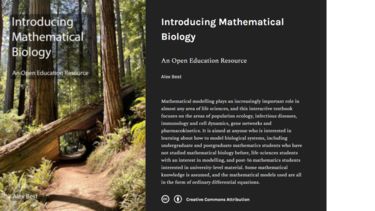
During the COVID-19 pandemic many of us needed to move our teaching materials online. Moreover, legislation requiring learning materials to meet certain accessibility requirements was a challenge for mathematics. Along with many colleagues, I investigated a number of ways of creating accessible, online learning materials. Knowing the considerable costs associated with traditional textbooks and e-books, I advertised my initial output - the teaching materials for a specific module - via social media and found there was reasonable interest amongst students and colleagues for freely available, interactive and easily accessible materials. This led me to explore the possibility of a fully OER textbook for undergraduate students in my field.
Process
I initially approached the University Library’s OER team to scope out the support that might be available. This began a close working relationship with the team which was an immense help. Not least, I was awarded a small amount of funding to pay for some teaching replacement and a student assistant to develop the OER textbook. A key choice I had was which platform to use - my existing content was on personal web pages hosted on Github, with the content created using Jupyter Book (a Python extension), but I was aware the University had an account with Pressbooks. I eventually decided to use Pressbooks due to its wider presence as a publisher and the ease of linking to a number of databases. I developed new content alongside my existing material, and with the student helper produced all the content on the Pressbooks platform. I received feedback on drafts from staff and PhD student colleagues in my department. The textbook was published in July 2023 after around six months of development.
Challenges
I was lucky to receive the funding from the Library’s OER team to allow me some time to focus on the project - it does take time! While I still believe using Pressbooks was the right choice, it was more of a challenge to typeset the mathematical material on the platform than when I used Jupyter Book. Being a textbook that brings together knowledge from across the field, I had concerns about how best to acknowledge sources, references and 3rd-party material, and sought advice on this from the OER team.
Benefits and impact
I have been utterly surprised at how well the textbook has been received in the community. In the first nine months of its publication, the site had over 8,500 visitors and there were over 3,500 downloads of the textbook. I have also had a number of colleagues at other institutions tell me they have used it as a suggested textbook on their own modules.
What’s next for you with OER?
A few colleagues in my department have spoken to me about my experience writing the textbook with an interest in creating their own. I think that free, online and accessible textbooks have huge benefits to students across the world, and I hope to see many more developed in mathematics in the coming years.
You can find Alex’s book at https://sheffield.pressbooks.pub/introducingmathematicalbiology/
- Dr Robert Chisholm, Research Software Engineer, Computer Science
Motivation
At the university, there is demand for training from research students and staff who require technical skills for their research, such as programming, version control and High Performance Computing (HPC). The delivery of this training falls to the Research IT (RIT) and Research Software Engineering (RSE) teams that are required to develop and deliver this training, sometimes at short notice.
The Carpentries (https://carpentries.org/) is a non-profit organisation dedicated to the teaching of foundational programming and data-science skills to researchers. The organisation maintains a wide range of instructor-led workshops and lessons under the CC-BY licence. They offer paid training to become a certified instructor in the delivery of workshops within their curricula; however, it is possible to ‘unofficially’ deliver their training due to the open licence. Furthermore, they provide guidance and resources for developing (and sharing) courses in their format/style. For this reason, The Carpentries are widely regarded within both the international and national research software engineering communities.
Several staff at the university within the RSE and RIT teams have completed Carpentries instructor training and subsequently run these courses for staff and PhD students, eg Image Processing with Python, Data Analysis and Visualisation in R, Plotting and Programming with Python, Introduction to the UNIX shell, and Conda environments for effective and reproducible research.
Moving Forwards: Giving Back
After using training resources from The Carpentries for several years, members of RSE and RIT are now developing new courses with The Carpentries infrastructure. These courses cover novel topics such as ‘Performance Profiling & Optimisation (Python)’, and are available as OER under the same CC-BY licence with plans to submit them to The Carpentries community once they have been refined.
Resources needed
Courses developed and maintained by The Carpentries, and additional ones from community contributors, can be found on their website grouped by Data, Software, Library & Community.
Each of these courses has links to corresponding short course websites, instructor notes and source repositories. Community courses also advertise their development status. Therefore, the minimum requirements to deliver a Carpentries short course are an internet connection and staff familiar enough with the topic to deliver the material.
Several staff have undertaken the Carpentry Instructor Training course and received certification on completion. Whilst not essential for delivery of the Carpentries material, those who undertook the training all found it a very positive and useful experience and other staff would likely benefit from completing the Carpentries’ paid instructor training too.
Challenges
No difficulties, outside of the normal friction when delivering others' materials, have been observed in delivering courses from The Carpentries.
Benefits and impact
The wide range of courses offered by The Carpentries can greatly shorten the time required to deliver bespoke and niche training courses for researchers at the University, either by utilising or building on their pre-existing training materials. Likewise, more capable students are often content with self-led learning following the teaching materials at their own pace.
https://datacarpentry.org/lessons/
https://software-carpentry.org/lessons/
Video case studies
Professor Louise Robson, Chair of the OER Working Group and Professor of Digital Innovation in Learning and Teaching
Louise highlights the University of Sheffield's commitment to Open Educational Resources, its OER policy and its inclusion of OERs in the Academic Career Pathway.

Dr Rebecca Barnes, Senior University Teacher, School of Biosciences
Rebecca explores the development of a co-authored collection of hypothesis-based Biosciences practical sessions using the Pressbooks platform and discusses her plans for making increased use of OERs in future.

Dr Matteo Di Benedetti and Dr Tom Howard, Centre for Engineering Education
Matteo details the strong support for the creation of OER within the Centre for Engineering Education, while Tom introduces his openly accessible robotics course, which he created using GitHub.

Professor Darren Robinson, Chair in Architectural and Urban Sciences
Darren discusses the creation of his open textbook Science and Technology of Low Carbon Design using the Pressbooks platform, and his experiences of piloting this among his students.

Andy Tattersall, Information Specialist, School of Medicine and Population Health
Andy describes the development of his interest and involvement in creating OERs, focusing on his podcast series Communicable Research, which showcases the work of Health academics in an accessible way.
